
Major UK Horse Racing Events to Bet On: Calendar, Prize Money & Betting Insights
Best Horse Racing Betting Sites – Bet on Horse Racing in 2026
Loading...
Why Major Events Matter More Than the Average Tuesday Card
The UK horse racing calendar is not a loose collection of afternoon fixtures scattered across the seasons. It is a structured ecosystem — one that generated a record £194.7 million in total prize money in 2025 and drew more than 5.031 million visitors through racecourse turnstiles for the first time since 2019. For anyone navigating the world of major UK horse racing events, that distinction matters. A Tuesday handicap hurdle at Plumpton and the Cheltenham Gold Cup share a sport, but they exist in different galaxies when it comes to market liquidity, bookmaker promotions and the sheer depth of form analysis available.
Major events reshape the betting landscape. Field sizes swell, ante-post markets open months in advance, and operators compete fiercely for your attention with enhanced odds, free bet offers and extra place terms. The casual once-a-year punter and the seasoned form student both gravitate towards these fixtures, which creates something rare in gambling: genuine value pockets alongside inflated promotional activity. Understanding how each flagship event works — its quirks, its traditions, its pricing patterns — is not academic. It is a direct route to better decisions with real money.
The pricing environment at major meetings is fundamentally different from everyday cards. On a standard afternoon, three or four bookmakers may offer near-identical odds, and the overround can sit comfortably above 120%. At Cheltenham or Royal Ascot, the competition for market share drives overrounds lower, Best Odds Guaranteed terms are applied more liberally, and operators roll out race-specific promotions — money-back if your horse finishes second, enhanced each-way terms, acca boosts across the card. Those concessions have real value, and they only appear at scale during the calendar’s flagship meetings. For the disciplined bettor, the biggest events are not just the most exciting — they are the most commercially advantageous.
This guide breaks down every event that matters on the British racing calendar. We will walk through Cheltenham, Grand National and Royal Ascot in detail, then cover the second-tier festivals that serious bettors should never ignore. We will look at where the prize money comes from, why field sizes at the biggest meetings are actually growing even as the overall horse population shrinks, and how the seasonal split between Flat and National Hunt racing shapes when and where the betting opportunities appear. Where the sport meets the spectacle — that is where this article lives.
Cheltenham Festival: Four Days That Define Jump Racing
Cheltenham Festival is the centrepiece of the National Hunt season. Four days in March, 28 races, and a betting turnover that William Hill projects will reach £450 million for the 2026 edition. Every single one of the 28 Festival races in 2025 ranked inside the top 31 most-wagered races of the entire year. No other fixture in British racing dominates the betting charts so comprehensively.
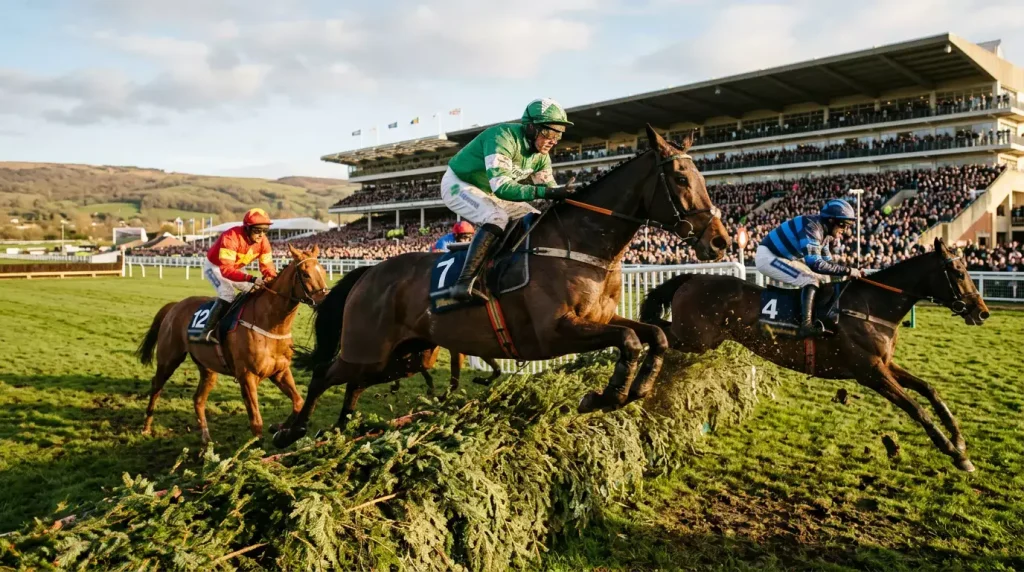
The structure is part of the appeal. Tuesday opens with the Supreme Novices’ Hurdle and builds towards the Champion Hurdle — often the race that sets the tone for the whole week. Wednesday belongs to the Queen Mother Champion Chase, a two-mile masterclass in speed and precision over fences. Thursday’s centrepiece is the Stayers’ Hurdle, but the Ryanair Chase tends to generate sharper ante-post movements. And then Friday: Gold Cup day. The race that defines a staying chaser’s career, run over three miles and two furlongs of Prestbury Park’s undulating terrain, where stamina is tested as brutally as class.
“Cheltenham is always the biggest betting week of the year for us,” says Henry Beesley of Fitzdares. “It is often called the Olympics of horse racing, and rightly so. The combination of top-class racing, incredible atmosphere and tradition makes it irreplaceable.” That description is not hyperbole when you consider the numbers. The ante-post markets for Cheltenham open as early as the previous spring, with serious money arriving from November onwards once the trials calendar heats up. A horse winning the Fighting Fifth Hurdle at Newcastle in late November will see its Champion Hurdle price shorten overnight — and the layers know it.
From a betting perspective, Cheltenham rewards preparation disproportionately. The Irish raiders, trained primarily by Willie Mullins and Gordon Elliott, have dominated recent renewals, but the market often overreacts to Irish form in handicaps while underpricing British-trained specialists in the graded races. The ground at Cheltenham is another variable that separates the informed from the hopeful: the Old Course and New Course configurations drain differently, and a switch from soft to good ground in the final 48 hours before the Festival can reshape entire markets. If you are going to bet seriously on one week of the year, this is the week. The liquidity is there, the data is there, and the bookmaker offers are at their most generous.
Grand National: The Race That Stops a Nation of Punters
If Cheltenham is the connoisseur’s festival, the Grand National is the nation’s race. According to Entain’s global data, the Grand National was the single most-wagered-upon sporting event in the world in 2025, generating 700% more bets than the Cheltenham Gold Cup and outpacing the Super Bowl for the second consecutive year. The three-day Aintree Festival generates an estimated turnover exceeding £250 million, with the Grand National itself accounting for more than £200 million in wagers.
What makes the National unique as a betting event is its audience. A YouGov survey conducted for OLBG found that 17% of all UK adults planned to place a bet on the 2025 Grand National, with 77% of respondents agreeing that betting on the race is part of British culture. Among those who do bet, 43% stake less than £10 — this is an event that pulls in millions of people who never touch a betting slip for the rest of the year. That influx of casual money changes the market dynamics entirely. Bookmakers extend their each-way terms, offer extra places, and compete on price in ways they simply do not bother with for a midweek novice hurdle.
The race itself is a handicap steeplechase over four miles and two furlongs, featuring 30 of the most famous fences in sport. The maximum field size was reduced to 34 runners in 2024 as part of safety enhancements, down from the traditional 40. The field size alone creates a mathematical reality that experienced bettors understand: picking the winner is brutally difficult, but identifying horses that will complete the course and finish in the frame is a more tractable problem. That is why each-way betting dominates the National. A 66/1 outsider placing fourth at quarter-the-odds pays handsomely, and the casual punter who picked a name they liked suddenly walks away with a return. It is this combination of accessibility and genuine unpredictability that sustains the Grand National’s cultural status.
Strategy for the National leans heavily on profiling. Horses aged between nine and eleven have the strongest historical record. Previous course form at Aintree — specifically over the National fences, which are unique in British racing — is a powerful indicator. Weight matters more in this race than in almost any other: the top weight has not won since Red Rum, and the sweet spot tends to sit between 10st 4lb and 11st 2lb. Punters who filter the 40-runner field through these lenses can usually narrow the realistic contenders to a shortlist of eight to twelve, which makes the each-way calculations far more manageable.
There is a darker side to the numbers, though. Grainne Hurst, CEO of the Betting and Gaming Council, has warned that “every year during the Grand National, the unsafe, unregulated black market absorbs almost £10 million in bets — fuelling crime, undermining player protections and sapping vital funds from sport and the Treasury.” For bettors, the message is straightforward: use UKGC-licensed operators. The protections — deposit limits, self-exclusion, regulated dispute resolution — exist only within the legal framework. The Grand National is a brilliant betting event, but only if you are placing your stakes in the right place.
Royal Ascot: Where Flat Racing Meets High Theatre
Royal Ascot occupies a different register entirely. Five days in June, 35 races, and the finest Flat racing programme assembled anywhere in the world. If Cheltenham is about stamina and guts, Ascot is about speed, class and breeding — and the betting markets reflect that distinction. Ante-post activity for Royal Ascot begins in earnest after the Guineas weekend in May, with the leading Classic contenders often having their Ascot targets flagged by connections weeks in advance.
The Group 1 races anchor the card. The Queen Anne Stakes opens the meeting on Tuesday, and its result immediately sets the narrative for the week. The Prince of Wales’s Stakes on Wednesday routinely attracts the middle-distance elite. Thursday delivers the Gold Cup, Ascot’s answer to the staying test — a two-and-a-half-mile contest that separates the truly durable from the merely talented. Friday and Saturday mix high-class sprinting (the Diamond Jubilee Stakes, the Commonwealth Cup) with the cavalry charges of the big-field handicaps, which tend to generate the largest individual betting pools of the week.
It is those handicaps that make Royal Ascot compelling from a punting perspective. The Royal Hunt Cup, the Wokingham Stakes and the Buckingham Palace Stakes regularly attract fields of 20-plus runners, and each-way terms become genuinely interesting when bookmakers extend to four or five places. The Flat form book is also more transparent by mid-June than jump form is in mid-March: horses have typically had one or two runs in the season, speed figures are reliable, and draw bias at Ascot — which is real, particularly on the straight course — gives the analytical bettor an edge the market sometimes underweights.
Beyond the racing, Royal Ascot’s dress code and Royal Procession are embedded in its identity. That pageantry draws a different crowd to the track — more corporate, more social — but it also ensures massive media coverage, which in turn drives betting volume. The atmosphere is different from Cheltenham’s roar, but the quality of the racing is, if anything, higher. Anyone building a serious annual betting calendar should treat Royal Ascot as a cornerstone, not a sideshow.
Beyond the Big Three: Goodwood, York, King George and More
The temptation is to stop at the big three, but doing so means missing some of the best value on the racing calendar. Glorious Goodwood, the five-day festival held each late July on the Sussex Downs, is a serious Flat meeting that consistently produces competitive handicaps and surprise results. The course itself — right-handed, undulating, with a sharp descent into the home straight — is idiosyncratic enough to create specialists. Horses that handle Goodwood tend to handle it repeatedly, and the form book rewards those who pay attention to course records.
The Stewards’ Cup, Goodwood’s marquee sprint handicap, regularly attracts fields of 25-plus runners and is one of the most betted-upon races outside the big three festivals. The Sussex Stakes, a Group 1 mile contest, typically features a small but elite field where the market is tight and the form is readable. For the punter who prefers analytical depth over atmospheric spectacle, Goodwood quietly offers more than Royal Ascot’s larger handicaps.
York’s Ebor Festival in August is another fixture that punches above its perceived weight. The Ebor Handicap itself is Europe’s richest Flat handicap, and the Juddmonte International routinely attracts a field that could grace any Group 1 anywhere on the continent. York is a galloping, fair track — draw bias is minimal, and the best horse tends to win, which is not always the case at more quirky venues. The Nunthorpe Stakes, a five-furlong dash, adds a different dimension: pure speed racing with fields that rarely exceed 15, making form analysis unusually straightforward.
On the National Hunt side, the King George VI Chase at Kempton on Boxing Day is the mid-season championship race. Run on a flat, right-handed track over three miles, it tends to favour speed over stamina — a contrast to the Cheltenham Gold Cup, which explains why some horses thrive at one venue and flounder at the other. The Scottish Grand National at Ayr in April provides a staying handicap chase that often sees big-priced finishers, while the Welsh Grand National at Chepstow in late December is a war of attrition on ground that can be bottomless. Both are worth a serious look for each-way punters who do their homework on conditions.
The common thread across all these events is that they are not afterthoughts. Trainers plan their seasons around them, bookmakers enhance their promotions for them, and the betting markets are deep enough to absorb meaningful stakes without prices collapsing. Treating these fixtures as secondary is a mistake that costs punters value every year.
Prize Money, the Levy and the Health of British Racing
The £194.7 million in total prize money paid out in 2025 did not materialise from thin air. The funding structure behind British racing is complex, and it directly affects the quality of the product you are betting on. Racecourse contributions accounted for roughly 53% of that total — about £103.4 million — making the tracks themselves the largest single funder. The Horserace Betting Levy Board (HBLB) budgeted £72.7 million for prize money in 2025, an increase of £2.2 million on the previous year, with a further £4.4 million earmarked for 2026. Owners’ prize money contributions and sponsorship filled the remainder.
The Levy merits a closer look because it connects the betting market directly to the sport’s financial health. Every licensed bookmaker pays a percentage of their gross profits on British racing into the Levy. In FY 2024/25 the yield reached a record £108.9 million — driven partly by the expansion to offshore operators introduced in the 2017 reform and by higher-than-usual bookmaker gross profits in February and March 2025, with results at the Cheltenham Festival a material factor. That money flows back into prize money, racecourse improvements, veterinary science and integrity services. When you place a bet on a British race with a UKGC-licensed bookmaker, a portion of the margin funds the very sport you are watching.
Yet beneath the headline growth sits a structural tension. The number of horses in training across Britain dropped to 21,728 in 2025 — a decline of 2.3% year on year — and the BHA projects a reduction of 6-7% in the number of races by 2027 compared with 2024 levels. Fewer horses mean smaller fields, particularly at the lower tiers of the fixture list. Average field sizes in 2025 were 8.90 on the Flat and 7.84 over jumps, both down on the prior year. The picture at the top end is more encouraging: Premier Fixtures saw field sizes rise to 11.02 on the Flat and 9.41 over jumps, which suggests the flagship meetings are concentrating the sport’s resources in a way that benefits bettors who focus on quality over quantity.
Kevin Walsh, Racing Director of the Racecourse Association, framed it as a positive trajectory: “The annual growth of 3.5% in prize money is a serious investment in the sport and an incentive for participants to run horses at British racecourses. We are seeing sustained growth in attendance figures despite the financial pressures affecting all stakeholders.” That growth in attendance — to over five million, with young racecourse visitors increasing by 17% to 211,447 — indicates that the live product remains strong. For bettors, the takeaway is that major events are getting bigger, better funded and more competitive, even as the sport contracts at the grassroots level.
The Racing Calendar: When to Bet on What
British racing runs year-round, but it splits into distinct codes and seasons that shape the betting calendar in ways a newcomer might not immediately grasp. National Hunt — jumps racing, encompassing hurdles and steeplechases — runs primarily from October through April. The core NH season builds from autumn, hits its peak at Cheltenham in March, and wraps with the Grand National and the Punchestown Festival in late April. During this window, the ground tends to be softer, the fields are smaller, and stamina is tested as much as speed. Ante-post markets for the major NH festivals typically open nine to twelve months in advance, with the most significant price movements occurring between November and February as the trial races are run.
The Flat season on turf occupies the opposite half of the year. It begins in earnest at the Craven Meeting in April, builds through the Classics in May and early June, peaks at Royal Ascot and continues through Glorious Goodwood and the Ebor Festival before the autumn programme at Ascot and Newmarket draws the curtain. Flat racing offers a different betting dynamic: speed figures are more reliable, sample sizes of form are larger, and the markets tend to be more efficient. The draw — which lane a horse starts from — becomes a significant factor at certain courses, particularly at Chester, Beverley and the straight course at Ascot, and factoring this in is not optional for anyone who takes Flat betting seriously.
Then there is All-Weather racing, which runs on synthetic surfaces at Lingfield, Wolverhampton, Kempton, Newcastle and Southwell throughout the year, including the months when turf racing is dormant. All-Weather cards lack the prestige of the turf programme, but they fill the calendar from November to March and provide a steady diet of competitive handicaps that can offer genuine betting value precisely because they attract less public attention. The All-Weather Finals Day in April has grown into a legitimate mini-festival in its own right.
For a bettor, the seasonal split means different strategies at different times. The winter is about National Hunt: studying the trials, watching how the ground develops through the season, and building positions in the ante-post markets. Spring transitions into the Flat: Classic trials at Newbury, Chester and Lingfield feed into the 2,000 and 1,000 Guineas at Newmarket, and the form lines established there carry through to Royal Ascot. Summer is handicap season on the Flat, with larger fields and more complex puzzles. Autumn brings the Champions Day at Ascot and the start of the NH campaign. There is no dead period — only shifts in where the best value sits. Knowing the calendar does not just help you plan your diary. It tells you when the betting market is at its most generous and when the smart money is already priced in.