
Forecast & Tricast Betting Explained: Predicting the Exact Finish
 Available in US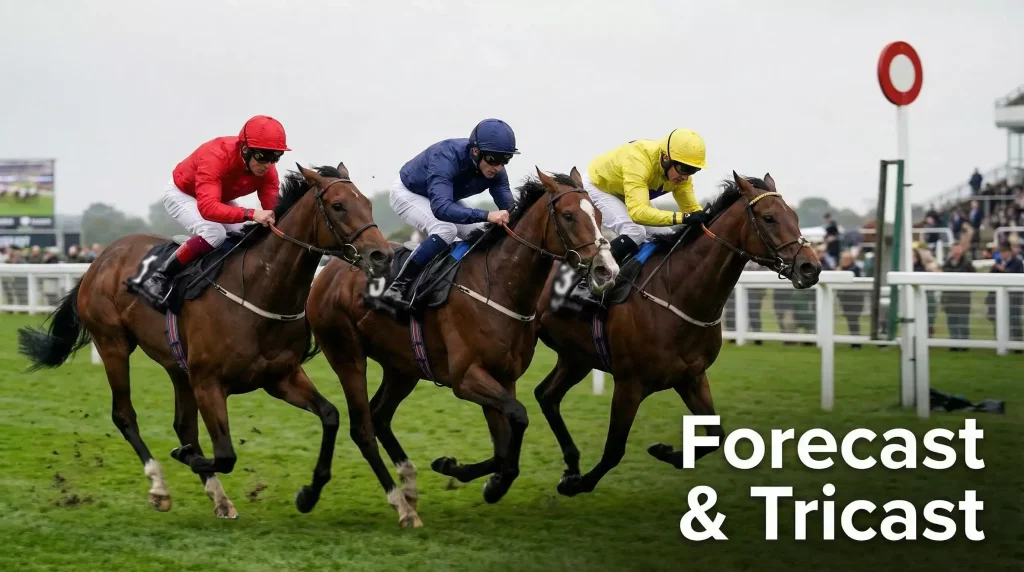
Betting on Order: Why Precision Demands a Different Approach
Forecast and tricast bets occupy the precision end of horse racing wagering. A Win bet asks you to find the winner. An each-way gives you a cushion if your pick finishes close. A forecast asks something much harder: name the first two home, in order. A tricast goes further still — the first three, in the exact sequence. The difficulty escalates quickly, and so do the potential returns. A straight forecast on two mid-priced horses can comfortably return 50/1 or more. A tricast in a competitive handicap has the potential to pay hundreds to one.
These are not bets for the casual Saturday punter dropping a fiver on the Grand National. Forecasts and tricasts reward form study, race reading, and the kind of granular assessment that goes beyond “I think this horse will win.” You need opinions not just on who finishes first, but on who finishes second and third — and you need those opinions to be correct simultaneously. Precision pays a premium, but it demands a corresponding level of homework.
Forecast Betting: Straight, Reverse and Combination
A straight forecast is the simplest version: you name the first and second in the exact order. Horse A to win, Horse B second. If they finish in that order, you collect. If they reverse positions — B first, A second — you lose. There is no partial payout for getting close. The return is determined either by fixed odds offered by the bookmaker or by the Computer Straight Forecast (CSF), which is a formula-based payout calculated after the race using the starting prices of the placed horses.
The CSF deserves a moment of attention. Most bookmakers settle forecasts at the CSF dividend by default, unless they are offering fixed forecast odds (which happens mainly on feature races). The CSF is calculated using a formula developed by the Jockey Club that takes the SPs of the first two finishers and the size of the field into account. The result is a payout that reflects the difficulty of predicting that specific combination. Two short-priced favourites finishing first and second produces a modest CSF; a 20/1 shot beating a 33/1 outsider into second produces a much larger one.
A reverse forecast covers both finishing orders: A first and B second, or B first and A second. It costs twice the stake of a straight forecast because it is, in effect, two bets. This is useful when you are confident about two horses filling the first two places but unsure which one will prevail. The trade-off is obvious: double the cost for double the coverage.
A combination forecast extends the principle to three or more selections. If you pick horses A, B, and C in a combination forecast, you are covering all possible first-and-second permutations: A-B, A-C, B-A, B-C, C-A, C-B — six bets in total. With four selections, you have 12 bets. The cost multiplies quickly, but the net captures a wider range of outcomes. Combination forecasts work best when you have identified a group of three or four horses that you believe will dominate the finish but cannot confidently separate them.
The BHA’s 2025 Racing Report shows average field sizes of 8.90 on the flat and 7.84 over jumps. In larger fields, the number of possible forecast outcomes grows exponentially — a 12-runner race produces 132 possible straight forecast combinations — which is why the payouts in bigger races tend to be significantly more generous. The maths of probability is working in the punter’s favour on the payout side, even as it works against them on the probability of landing the bet.
Tricast Betting: Predicting the First Three Home
A tricast takes the forecast concept one step further: you predict the first three finishers in exact order. Horse A wins, Horse B is second, Horse C is third. If any of those three finishes out of position, the bet loses. The complexity is significant — in a 10-runner race, there are 720 possible tricast outcomes — and the returns reflect that difficulty. Computer Tricast dividends of several hundred pounds from a £1 stake are not unusual in competitive handicaps, and four-figure payouts, while rare, do occur.
A straight tricast is the minimum-cost version: one combination, one stake. A combination tricast covers all possible orderings of your three (or more) selections. With three horses, that means six permutations. With four, it is 24. With five, the cost reaches 60 unit stakes — which starts to make the bet expensive relative to the probability of success. Most experienced tricast bettors stick to three or four selections and accept that they are playing a low-probability, high-reward game.
Tricasts are only available in races with a minimum of three runners declared at the time the race starts, though in practice most bookmakers only offer tricast betting on races with eight or more runners. This makes sense: in a four-horse race, a tricast is only marginally harder than a forecast, and the payout would not justify the additional complexity. The tricast comes into its own in larger, more competitive fields where separating the top three is a genuine analytical challenge.
One thing to be aware of: tricast bets placed with fixed odds at the bookmaker can pay differently from the Computer Tricast dividend. Some operators offer fixed tricast odds on selected races, which can be either more or less generous than the Computer Tricast. Comparing the two requires checking the terms of your specific bookmaker, but the CSF/CT dividends remain the default settlement method for most forecast and tricast bets in UK racing.
When Forecast and Tricast Bets Make Sense
Forecast and tricast bets are not appropriate for every race, and knowing when to deploy them is as important as knowing how they work. The ideal conditions are small to medium fields with strong form lines — races where your study of the card gives you a genuine opinion about the likely finishing order, not just a vague sense of who might win.
Conditions races and novice events often produce the best forecast opportunities. These races tend to have smaller fields — six to ten runners — where the form is more readable and the market has less room to misprice. A Class 2 novice hurdle with seven runners, where two horses stand out clearly on form and a third looks the most likely to fill the minor place, is a natural forecast and tricast scenario. The field is small enough that your analysis covers most of the contenders, and the odds are long enough to make the precision worthwhile.
Big-field handicaps sit at the opposite end of the spectrum. With 16 or more runners and closely matched handicap ratings, predicting the exact order of the first two or three becomes more akin to a lottery. The payouts are bigger, but the probability of landing a straight forecast or tricast drops sharply. Combination bets help, but the cost of covering enough permutations in a 20-runner handicap can quickly outstrip any reasonable staking plan. Among the roughly 15% of UK adults who bet on racing monthly — the demographic that drives most of the handle, according to BetVictor data — forecasts and tricasts tend to be the province of more experienced bettors who understand the risk-reward structure and choose their races carefully.
The bottom line: use forecasts and tricasts selectively, in races where your form assessment gives you a strong opinion about more than just the winner. If you only have a view on who will win, stick to a Win or each-way bet. If you have a confident read on the likely first two or three, that is when forecast and tricast betting earns its place in your repertoire.
Forecast & Tricast Betting Explained — More on this topic at horse racing sportsbook.
See also Lucky 15 Bet Explained.
