
Horse Racing Bet Types Explained: From Each-Way Singles to Accumulators
 Available in US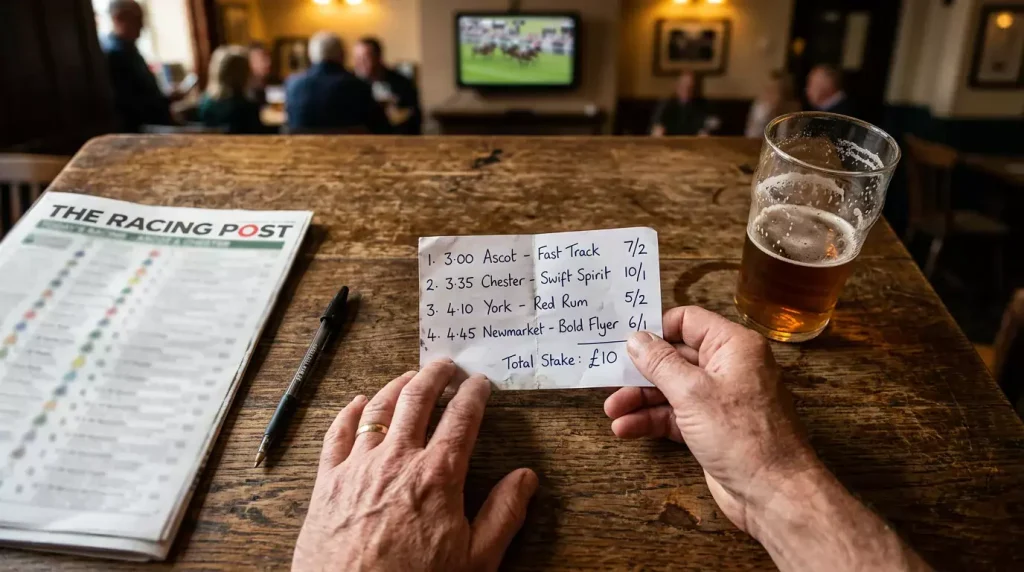
Why the Type of Bet Matters as Much as the Selection
UK horse racing offers a wider range of bet types than any other sport. A football match gives you win, draw, lose and a handful of side markets. A race at Cheltenham gives you Win, Each-Way, forecasts, tricasts, accumulators, Tote pools, ante-post markets and a range of specialist options that most bettors never explore. That variety is not decoration — it is the architecture of the sport’s betting ecosystem, and understanding it is a direct route to extracting better value from every meeting you punt on.
The problem is that many bettors default to the same type of bet regardless of the circumstances. A Win single on the favourite. Maybe an each-way if they fancy something at longer odds. According to survey data from BetVictor, roughly 15% of UK adults bet on horse racing at least once a month, and the 25-34 age bracket leads the way at 32%. A significant portion of that audience has never placed a forecast, never entered a Placepot, and has no clear idea what ante-post terms mean. They are not making bad bets, necessarily — but they are making uninformed ones, and that ignorance has a cost over hundreds of selections.
This guide walks through every major bet type available on British racing, from the simplest Win bet to the most niche specialist markets. Each section explains the mechanics, shows you the maths with real examples, and tells you when that bet type offers genuine value versus when it is a worse deal than the alternative. Know the bet before you place it — that principle separates the bettor who understands probability from the one who simply hopes for the best.
Win and Each-Way: The Foundation of Racing Bets
A Win bet is the simplest wager in horse racing: you pick a horse, stake your money, and collect if it finishes first. Nothing else counts. If it finishes second by a nostril, you lose. The price you take — whether 2/1, 10/1 or 33/1 — represents the bookmaker’s assessment of probability, and your return is the stake multiplied by those odds. There is no complexity here, and for many bettors, particularly those backing short-priced favourites, a Win single is the correct choice. The overround is lowest on Win markets, meaning the bookmaker’s margin is at its tightest.
Each-Way betting adds a layer. An each-way bet is actually two bets: a Win bet and a Place bet, at equal stakes. If your horse wins, both parts pay out. If it finishes in the places but does not win, only the Place part pays — at a fraction of the Win odds. The fraction depends on the race type and field size. In most non-handicap races with 5-7 runners, the terms are 1/4 of the odds for the first two places. In handicap races with 8-15 runners, it is typically 1/5 of the odds for the first three places. In large-field handicaps with 16 or more runners — think the Grand National or the Cesarewitch — some bookmakers pay four places, and during major festivals, extended place terms of five, six or even seven places are common as promotional offers.
The maths is worth working through with a concrete example. You back a horse each-way at 10/1 with a £5 stake. That is £10 total — £5 on the Win, £5 on the Place. If the horse wins in a race paying 1/4 the odds for three places, you collect £55 on the Win part (£5 x 10 + your stake) and £17.50 on the Place part (£5 x 2.5 + your stake), for a total return of £72.50 from a £10 outlay. If the horse finishes second or third, you lose the Win part but collect £17.50 from the Place part — a £7.50 profit on a £10 bet. If it finishes fourth or worse, you lose the full £10.
Understanding when each-way betting offers value is one of the most important skills in racing. The key insight is that each-way bets are most valuable when the place fraction is generous relative to the horse’s chance of placing. In a 20-runner handicap where bookmakers are paying four places at 1/4 odds, a 16/1 shot has each-way value even if it has only a modest chance of winning, because the place part of the bet is effectively 4/1 — and in a competitive handicap, a horse at that price will place more often than the 4/1 implies. Conversely, in a five-runner Group 1 where only two places are paid at 1/4 odds, each-way betting on a 5/1 outsider is usually poor value because the place odds (5/4) barely compensate for the higher probability of not placing in a small field. A YouGov survey found that 43% of Grand National bettors stake less than £10 — many of them backing each-way, which makes sense in a large-field race where extended place terms offer genuine protection.
Doubles, Trebles, Accumulators and Full-Cover Bets
A double is two selections in different races — both must win for the bet to pay. A treble is three. An accumulator (or acca) is four or more selections linked together, with the returns from each winner rolling into the next. The appeal is obvious: a £5 four-fold accumulator at average odds of 4/1 per leg returns £1,280 if all four win. The reality is equally obvious: the probability of all four winning is low, and the bookmaker’s margin compounds through each leg. If each individual selection has a 20% chance of winning, the probability of all four landing is 0.16% — roughly one in 625 attempts.
That does not mean accumulators are irrational. It means they serve a specific purpose: high potential returns from small stakes, accepted as entertainment rather than strategy. Where they become genuinely interesting is in each-way accumulators, where the place part of each leg still pays even if the win part fails. An each-way four-fold at decent prices can return meaningful money even with only two or three winners, provided the losing legs finish in the places.
Full-cover bets are where the complexity — and, for some bettors, the value — increases. A Lucky 15 consists of 15 bets on four selections: four singles, six doubles, four trebles and one four-fold. Because it includes singles, a single winner still produces a return, and most bookmakers offer consolation bonuses — typically double odds for one winner and a bonus (often 10-15% extra) if all four win. A Lucky 31 (five selections, 31 bets) and Lucky 63 (six selections, 63 bets) follow the same structure at larger scale. The Yankee (11 bets on four selections, no singles) and Patent (seven bets on three selections, including singles) sit alongside these as popular full-cover formats.
The Heinz — 57 bets on six selections — is the outer limit of practical full-cover betting. Beyond that, the stake required becomes prohibitive for most recreational bettors. The question with any full-cover bet is whether the insurance provided by the smaller combinations justifies the increased total stake. A Lucky 15 at £1 per line costs £15. If you are confident in all four selections, a straight four-fold at £15 is higher-risk but higher-reward. If you suspect one or two might let you down, the Lucky 15 provides a safety net. The answer depends on your confidence level and your tolerance for variance — but the point is that you should be making that calculation consciously, not defaulting to one format out of habit.
Forecast and Tricast: Predicting the Finishing Order
A forecast bet requires you to predict which horse finishes first and which finishes second, in the correct order. A straight forecast names Horse A to win and Horse B to finish second — if they finish the other way around, you lose. A reverse forecast covers both permutations (A first, B second, or B first, A second) but costs twice as much because it is effectively two bets. A combination forecast allows you to select three or more horses and covers all possible first-and-second combinations between them — the number of bets escalates quickly. Three horses produce six permutations, four horses produce twelve, and five horses produce twenty.
Tricast betting extends the principle to the first three finishers in correct order. A straight tricast names three specific horses to finish first, second and third in that exact sequence. A combination tricast on four horses covers 24 permutations. On five horses, it covers 60. The stakes add up rapidly, which is why tricast betting tends to appeal to punters who have a strong opinion on a small number of horses in a race and want to leverage that opinion for larger returns.
The pricing mechanism for forecasts and tricasts varies. Fixed-odds forecasts are available at most sportsbooks — you can see the exact payout before you place the bet. The alternative is the Computer Straight Forecast (CSF) or Computer Tricast (CT), which are calculated after the race based on the starting prices of the horses involved. CSF payouts are often more generous than fixed-odds forecasts, particularly when the first and second finishers are at longer prices, because the dividend reflects the actual market rather than a pre-set price. However, CSF payouts can also be lower than expected when favourites dominate the finish — there is no guarantee that the computer calculation will beat the fixed odds.
Tactically, forecasts work best in races where you have a strong view on two or three horses but are uncertain about the winner. A reverse forecast on your top two selections in a competitive handicap can offer better value than a Win single on either of them individually, because the returns reflect the difficulty of predicting the finishing order. The trap is overcomplicating things: a combination forecast on five horses involves 20 bets, and the combined stake can exceed the expected value unless the prices are long enough to justify the coverage.
Tote and Pool Betting: Sharing the Pot
Pool betting operates on a fundamentally different model from fixed-odds bookmaking. When you place a Tote bet, your stake goes into a shared pool with all other bettors on the same market. The Tote deducts its takeout — a flat 27% across most bet types — and divides the remainder among the winners. The dividend is declared after the race and depends on how much was staked on each outcome. If you back a 20/1 outsider on the Tote and few others have, the pool dividend can far exceed the fixed-odds return. If you back the favourite, the dividend will often be lower than the SP because the majority of pool money sits on the same horse.
The basic Tote bets mirror the fixed-odds market: Tote Win, Tote Place, Exacta (first and second in correct order, equivalent to a straight forecast) and Trifecta (first three in correct order, equivalent to a tricast). The dividends on these tend to fluctuate around the fixed-odds equivalents, sometimes better, sometimes worse, with the 27% takeout acting as a drag on average returns. Where pool betting becomes genuinely compelling is in the accumulator-style pools.
The Placepot is the most popular Tote pool bet and one of the best-value wagers in racing. It requires you to select a horse to place in each of the first six races at a meeting. A £1 Placepot stake buys you one entry, and if your selections all place, you share in the pool dividend. The average Placepot dividend across all UK meetings runs at roughly £400 to £500 per £1 stake, though this average is heavily skewed by occasional very large payouts when results go against the crowd. At a competitive midweek meeting, a Placepot might pay £50 to £150. At a major festival with big fields and unpredictable results, dividends of several thousand pounds are not unheard of — the record Cheltenham Festival Placepot paid £182,567 from a £2 entry in 2019.
The Jackpot — picking the winner of all six races — is the Tote’s high-risk, high-reward pool. Dividends can reach tens of thousands for a £1 stake, but the hit rate is vanishingly low. The Quadpot (placing in races 3-6 only) offers a middle ground with lower dividends but a higher strike rate. The Scoop6, which runs on Saturday afternoons, requires winners in six nominated races and regularly generates six-figure pools with potential bonus funds rolling over from previous weeks.
The strategic appeal of pool betting lies in going against the crowd. If you identify a horse that you believe will place but that the general public has overlooked, the pool dividend rewards you disproportionately. This is the opposite of fixed-odds betting, where the bookmaker sets the price and it does not change based on what other punters do. In a pool, contrarian selections carry a structural edge — provided they are correct.
Ante-Post Betting: The Long Game
Ante-post betting means placing a bet on a race before the final declarations are made — typically days, weeks or months in advance. The most active ante-post markets in UK racing are for the major festivals: Cheltenham, the Grand National, Royal Ascot and the Classics. William Hill has forecast that betting turnover on the Cheltenham Festival 2026 will reach £450 million, and a substantial portion of that figure is placed ante-post — some of it months before the first race.
The advantage of ante-post betting is price. Because you are accepting the risk that your horse might not run — through injury, a change of plan by the trainer, or failure to meet eligibility requirements — bookmakers offer longer odds than they would on the morning of the race. A horse that is 10/1 ante-post in November might be 5/1 by the time the Cheltenham Festival arrives. If you backed it early and it wins, you collect at the bigger price. The trade-off is the non-runner risk: under standard ante-post rules, if your horse does not run, your stake is lost. There is no refund, no void, nothing.
Non-Runner No Bet (NRNB) terms change that equation. Some bookmakers offer NRNB on selected ante-post markets, meaning your stake is returned if the horse is withdrawn. The prices under NRNB terms are shorter than standard ante-post prices — the bookmaker is absorbing the non-runner risk, and you pay for that protection through reduced odds. Whether NRNB represents better value depends on the individual horse and the perceived risk of withdrawal. A fragile jumper with a history of setbacks might be worth backing NRNB despite the shorter price. A well-established Flat horse with a clear target is probably better backed at the bigger standard ante-post price.
Timing is the critical skill in ante-post betting. Markets are at their least efficient in the very early stages — the summer ante-post lists for the following year’s Cheltenham, for example, are priced loosely and can contain significant value for those who follow National Hunt racing closely. As the season progresses and trial results narrow the picture, prices contract. The sweet spot for many ante-post punters is after the key trials have been run but before the final declarations, when the information is relatively complete but the prices have not yet collapsed to their final-day levels. This requires patience and discipline, but the expected value of well-timed ante-post bets consistently outperforms equivalent bets placed on the morning of the race.
Specialist Markets: Match Bets, Without the Favourite and More
Beyond the standard menu of bet types, UK horse racing supports a range of specialist markets that cater to different angles and interests. Match bets pit two specific horses against each other — you are betting on which one finishes ahead of the other, regardless of where either finishes in the overall race. This removes the unpredictability of the wider field and focuses the bet on a direct comparison. Match bets are particularly useful in races where you have a view on relative form between two horses but are uncertain whether either will win outright.
Betting Without the Favourite is another market that strips away a layer of uncertainty. The favourite is removed from the field, and you bet on which of the remaining horses finishes first. This market often throws up value because the favourite’s removal reshuffles the implied probabilities, and the bookmaker’s repricing does not always accurately reflect the true chances of the remaining runners. If a dominant favourite is expected to win comfortably, the Betting Without market is where the real contest takes place — and the pricing can be less efficient than the main Win market.
Top Trainer and Top Jockey markets are festival specials, most commonly available at Cheltenham and Royal Ascot. You bet on which trainer or jockey will have the most winners across the meeting. These markets reward knowledge of broader patterns — which stables are in form, which jockeys ride particular courses well, how entries are distributed — rather than individual race analysis. The ante-post Top Trainer market for Cheltenham typically opens in January and sees significant trading as entries are confirmed.
Insurance specials — money-back if your horse finishes second, or money-back if beaten by a specific distance — are technically promotional offers rather than distinct bet types, but they alter the expected value of a standard Win bet in ways that are worth understanding. A money-back-if-second offer on a horse at 5/1 effectively gives you a free each-way component, which changes the value calculation significantly. Greg Ferris, Managing Director of Sports at Entain, has noted the breadth of sporting interests across their customer base, from Cheltenham to the Champions League — and that diversity of demand drives the range of specialist markets operators now provide. With 48% of UK adults having gambled in the past four weeks according to the Gambling Survey for Great Britain, bookmakers have a commercial incentive to keep expanding the menu. For the informed bettor, each new market type is another opportunity to find an edge.
Horse Racing Bet Types Explained — More on this topic at horse racing sportsbook.
See also Best Horse Racing Apps UK 2026.
