
Horse Racing Odds Explained: Fractional, Decimal and Implied Probability
 Available in US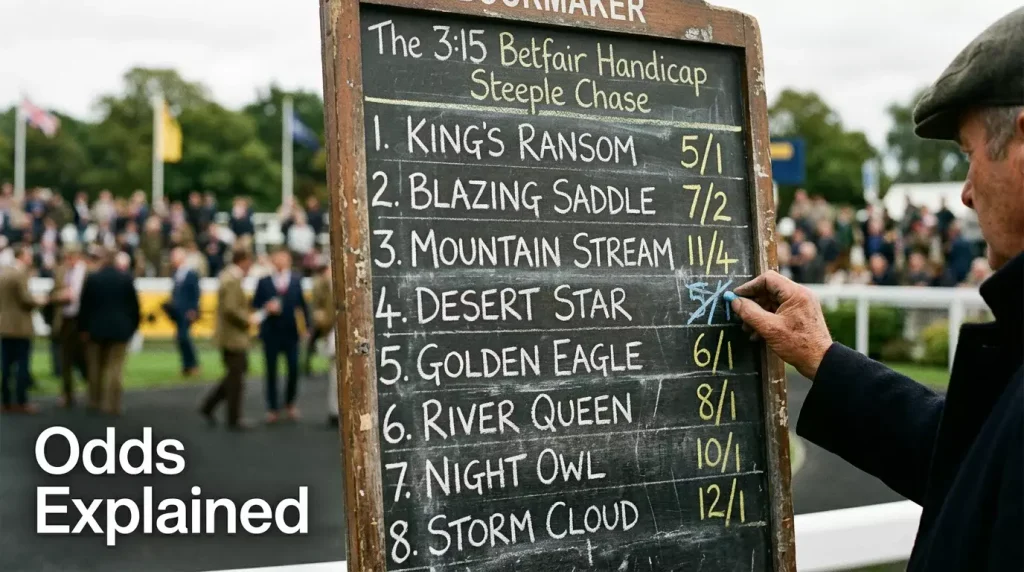
Numbers That Tell You Who the Market Believes In
Every set of odds on a horse racing market is two things at once: a statement about how much you could win, and a statement about how likely the market thinks that outcome is. A horse at 4/1 pays four times your stake if it wins — but it also implies the market rates its chance of winning at roughly 20%. Understanding that dual nature is the foundation of everything that follows: comparing prices between bookmakers, calculating expected returns, identifying value, and knowing when the market is overpricing or underpricing a runner.
In the UK, odds are traditionally displayed as fractions — 5/1, 11/4, evens — though decimal formats are increasingly common on bookmaker apps. Elsewhere in Europe, decimal odds are the default. In America, a different system entirely prevails. The underlying mathematics is the same regardless of format, but converting fluently between them — and understanding what each representation tells you about the market’s view — gives you an analytical advantage over punters who simply look at the potential payout without interrogating the probability behind it. The odds are not just numbers on a screen. They are the market’s collective judgment, expressed in a format that you can interrogate, challenge, and — if you are right — profit from.
Fractional Odds: The UK Standard
Fractional odds are the traditional format used in British horse racing, and they remain the default display on most UK bookmaker sites and racecards. A price of 5/1 (read as “five to one”) means you win £5 for every £1 staked, plus your stake back. A price of 11/4 means you win £11 for every £4 staked. Evens (1/1) means you win the same amount as your stake. Odds-on prices — such as 4/5 or 1/2 — mean you win less than your stake: at 1/2, you win 50p for every £1 bet.
To calculate the return on any fractional odds: multiply your stake by the fraction and add the stake. A £10 bet at 7/2 returns £10 x (7/2) + £10 = £35 + £10 = £45. A £5 bet at 11/8 returns £5 x (11/8) + £5 = £6.875 + £5 = £11.875. The maths is straightforward once you treat the fraction as a multiplier.
Converting fractional odds to implied probability — the market’s estimated chance of the horse winning — requires a simple formula: probability = denominator / (numerator + denominator). For a horse at 4/1: 1 / (4 + 1) = 0.20, or 20%. For a horse at 6/4: 4 / (6 + 4) = 0.40, or 40%. For an odds-on favourite at 4/5: 5 / (4 + 5) = 0.556, or about 56%. These implied probabilities tell you what the market thinks, and comparing them to your own assessment is how you find value — selections where you believe the true probability is higher than the market implies.
This pricing system operates across a UK online horse racing market that generated £766.7 million in gross gambling yield in 2024/25. Every pound of that yield flows through odds that punters either accepted at face value or interrogated for value. The punters who consistently check the implied probability behind the price are, by definition, making more informed decisions than those who simply look at the potential payout.
Decimal and American Odds: The Other Formats
Decimal odds are the standard in continental Europe and are increasingly common on UK betting sites, where most operators let you switch between fractional and decimal display. Decimal odds represent the total return per unit staked, including the stake. A horse at 5/1 fractional is 6.0 decimal — your £1 bet returns £6 total (£5 profit plus £1 stake). Evens is 2.0. A 1/2 shot is 1.5.
The conversion from fractional to decimal is: decimal = (numerator / denominator) + 1. From 7/2: (7 / 2) + 1 = 4.5. From 11/4: (11 / 4) + 1 = 3.75. Decimal odds make return calculations simpler — just multiply your stake by the decimal number — and they make comparing prices across different fractions faster. When a bookmaker offers 11/4 and another offers 3.0 decimal on the same horse, the decimal comparison (3.75 vs 3.0) is instantly clear.
American odds are less commonly encountered in UK horse racing but appear on international sites and in coverage of American racing. They use a baseline of 100: positive numbers (e.g., +400) show the profit on a $100 stake, while negative numbers (e.g., -150) show how much you need to stake to win $100. A horse at 4/1 fractional is +400 American; a horse at 4/6 is -150. For UK horse racing punters, the main value of understanding American odds is recognising them when they appear on global comparison tools or in coverage of races like the Breeders’ Cup.
Implied probability works the same way regardless of the format: decimal probability = 1 / decimal odds. A horse at 4.0 decimal has an implied probability of 25%. A horse at 1.5 decimal has an implied probability of 66.7%. The format is just a wrapper — the underlying probability statement is identical.
The Overround: Why the Market Always Adds Up to More Than 100%
If you convert the odds of every horse in a race to implied probabilities and add them together, the total will always exceed 100%. A 10-runner race might add up to 112% or 118%. That excess — the amount above 100% — is the overround, and it represents the bookmaker’s built-in margin. An overround of 115% means the bookmaker is effectively charging you 15% for the privilege of betting into that market.
To calculate the overround: convert each horse’s odds to decimal, calculate 1/decimal for each, sum them, and express as a percentage. If a five-runner race has horses priced at 2.0, 4.0, 6.0, 8.0, and 10.0 decimal, the implied probabilities are 50%, 25%, 16.7%, 12.5%, and 10% — totalling 114.2%. The overround is 14.2%. That margin is not distributed equally across all runners: bookmakers typically embed more margin in the prices of outsiders than in the prices of favourites, which is why the favourite’s implied probability is usually closer to its true probability than an outsider’s.
On the Betfair Exchange, the overround is typically much lower — often 2–5% on liquid markets — because the prices are set by competition between users rather than by a bookmaker managing its margin. However, the exchange charges commission (currently 6% base rate for UK horse racing) on net winnings, which partially offsets the tighter market. Comparing the effective cost of betting on an exchange versus a sportsbook requires factoring in both the overround and the commission — and the calculation changes depending on whether you are backing short-priced selections (where the exchange advantage is smaller) or longer-priced ones (where it is more significant).
Value exists when your assessment of a horse’s true probability of winning exceeds the implied probability reflected in the odds. If the market prices a horse at 6/1 (implied probability 14.3%) and you believe its true chance is 20%, that is a value bet. The horse will still lose four times out of five, but over hundreds of bets at prices that consistently underestimate the true probability, a positive ROI emerges. That is the core principle of professional horse racing betting — and it starts with understanding what the odds are actually telling you.
Horse Racing Odds Explained — More on this topic at horse racing sportsbook.
See also Irish Horse Racing Betting from the UK.
