
All-Weather Horse Racing Betting: UK Tracks, Surfaces & Form Tips
 Available in US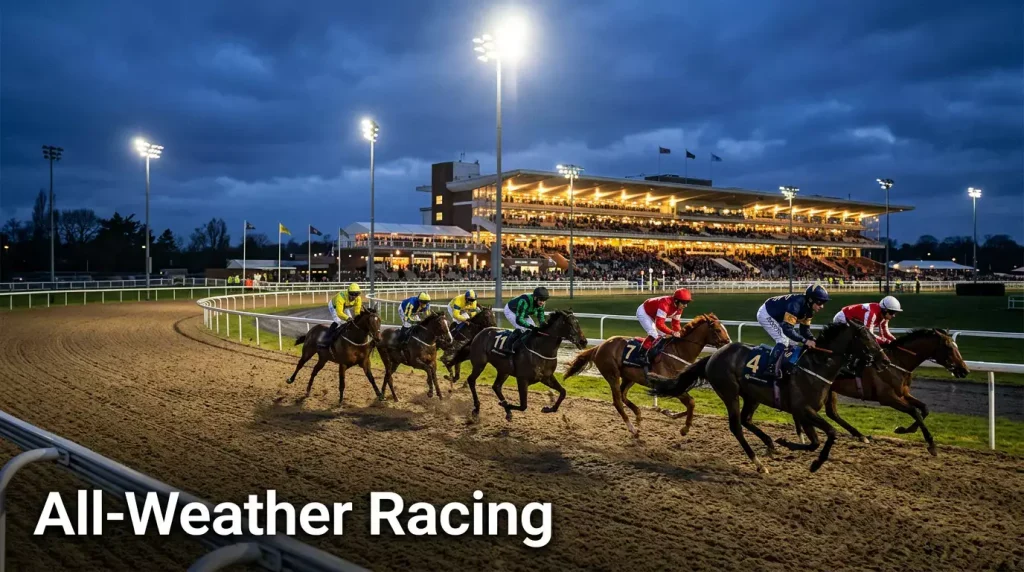
Year-Round Racing on Synthetic Surfaces
When the turf season closes and the jumps calendar narrows to a handful of weekend meetings, all-weather racing keeps the UK programme running without interruption. Six tracks — Lingfield, Wolverhampton, Kempton, Newcastle, Chelmsford, and Southwell — host flat racing on synthetic surfaces throughout the winter and across the full calendar, providing a continuous stream of betting opportunities that never shuts down for the weather, the ground, or the season. Racing never stops, and for punters willing to study the nuances of these tracks, all-weather fixtures offer genuine value precisely because the mainstream audience tends to look the other way.
All-weather racing has a lower profile than the turf Flat or the jumps code, but the market volume is real — these meetings generate significant handle, particularly on midweek evening cards that fill the gap between Saturday’s big turf meetings. The horses, trainers, and jockeys who specialise in all-weather racing often develop form patterns that are more consistent and more predictable than the wider sport, creating opportunities for punters who invest the time to understand the surfaces and the tracks.
Polytrack, Tapeta and Fibresand: How the Surfaces Differ
The three synthetic surfaces used at UK all-weather tracks are not interchangeable, and treating them as equivalent is a mistake that costs punters money. Each surface plays differently in terms of speed, kickback, drainage, and bias — and form on one surface does not always transfer to another.
Polytrack is the most widely used surface, installed at Lingfield, Kempton, and Chelmsford. It is a wax-coated blend of sand, fibre, and recycled materials that produces a consistent, relatively fast racing surface. Polytrack drains well, rarely rides materially differently from one day to the next, and tends to favour horses with a smooth, economical running style. Draw biases on Polytrack vary by track configuration: at Lingfield’s sharp, left-handed circuit, low draws can hold an advantage over shorter distances, while at Kempton’s right-handed, more galloping track the draw is less pronounced.
Tapeta is the surface at Wolverhampton and Newcastle. It consists of sand, wax, and fibres in a slightly different formulation from Polytrack, producing a surface that rides marginally slower and can vary more with temperature and moisture levels. Wolverhampton’s tight, floodlit, left-handed track is one of the most distinctive venues in UK racing, with significant draw biases over certain distances — high draws over five furlongs, for instance, have historically outperformed low draws. Newcastle’s wider, left-handed track with its long home straight is more galloping in character and tends to be fairer from a draw perspective.
Fibresand, used at Southwell, is the outlier. It is a sand-based surface with a higher proportion of fibre, producing a notably deeper, more demanding track that rewards stamina over speed. Form on Fibresand is the least transferable to other surfaces, and horses that thrive at Southwell often struggle on Polytrack and vice versa. The number of horses in training in the UK fell to 21,728 in 2025, according to the BHA’s annual report — a 2.3% decline — and that shrinking pool means the same horses recur more frequently at all-weather venues, creating form patterns that attentive punters can exploit.
Form Factors: Draw Bias, Specialists and Course Records
Draw bias is more statistically significant at all-weather tracks than at most turf venues, because the artificial surfaces are more consistent and the track configurations are fixed. At Wolverhampton, the tight bends amplify the advantage of a favourable draw position, particularly over sprint distances. At Lingfield, the downhill start and sharp bend into the straight on the seven-furlong course create a specific dynamic where prominent racers from low draws hold a structural edge. At Newcastle, the wide track and long straight tend to reduce draw bias, but it does not disappear entirely in big fields.
Trainer and jockey specialists are a genuine feature of all-weather racing. Certain trainers — who campaign strings of horses primarily on the all-weather circuit — develop course records at specific tracks that materially outperform their overall strike rates. A trainer with a 25% record at Wolverhampton but a 10% overall rate is telling you something important about their targeting. Similarly, jockeys who ride the all-weather circuit frequently build track knowledge that translates into consistently better performances at their preferred venues.
All-weather form should be assessed separately from turf form. A horse that ran well on Polytrack at Kempton last month is a different proposition from one whose last run was on Good to Firm turf at Ascot. The surfaces reward different physical attributes — all-weather surfaces tend to suit horses with a lower, more efficient action, while turf rewards a bigger, more powerful stride. When a horse switches between surfaces, its form line requires recalibration, and the transition produces more upsets than a like-for-like surface switch would suggest.
Where the Value Sits on the All-Weather Circuit
The lower-profile nature of all-weather meetings creates a market dynamic that works in the punter’s favour. The betting markets on midweek all-weather cards are typically less sharp than those on Saturday turf meetings — fewer professional bettors are engaged, less media analysis is available, and the bookmaker’s pricing team has less external data to draw on. This means that pricing inefficiencies persist for longer, and punters who do their homework can find value that would be competed away in minutes on a higher-profile card.
BHA data shows that field sizes on Core Fixtures — which includes the majority of all-weather meetings — have been declining, while Premier Fixture field sizes have grown. That declining field-size trend on the all-weather circuit means smaller, more manageable races with fewer variables to assess. A six-runner conditions race at Wolverhampton on a Tuesday evening, where you can study the form of every runner in detail, offers a very different analytical challenge from a 20-runner Ascot handicap where half the field is unexposed.
Speed ratings — performance figures that adjust finishing times for track, distance, going, and weight — are particularly useful on the all-weather because the surface consistency reduces the number of variables that distort raw times on turf. A horse that posted a fast time-figure at Kempton last month is more likely to reproduce that level on the same surface than a horse that ran a fast time at a rain-affected turf meeting where the ground varied across the track. For punters who use speed ratings as part of their analysis, all-weather racing is the most reliable code in which to apply them.
The competitive depth on the all-weather circuit also creates value for forecast and tricast bettors. Smaller fields with familiar horses whose form lines interlock predictably make it easier to form opinions about the finishing order beyond just the winner. A six-runner race at Lingfield where you have studied the form of all six horses is a natural forecast opportunity — and the CSF dividends in smaller fields, while less spectacular than in big handicaps, offer a more consistent return for punters who can separate the first two or three home with reasonable accuracy.
Finally, all-weather racing rewards consistency. The absence of going variation, the fixed track configurations, and the recurring horse populations all favour punters who build databases, track trainer patterns, and monitor draw statistics over time. The glamour of Royal Ascot or Cheltenham may not attach to a Monday evening at Wolverhampton, but for bettors who treat horse racing as a year-round analytical exercise rather than a seasonal spectacle, the all-weather circuit is where the steadiest opportunities live.
All-Weather Horse Racing Betting — More on this topic at horse racing sportsbook.
See also Horse Racing Price Boosts, Extra Places and Promos for Existing….
