
In-Play Horse Racing Betting: Live Markets, Odds Movement & Strategy
 Available in US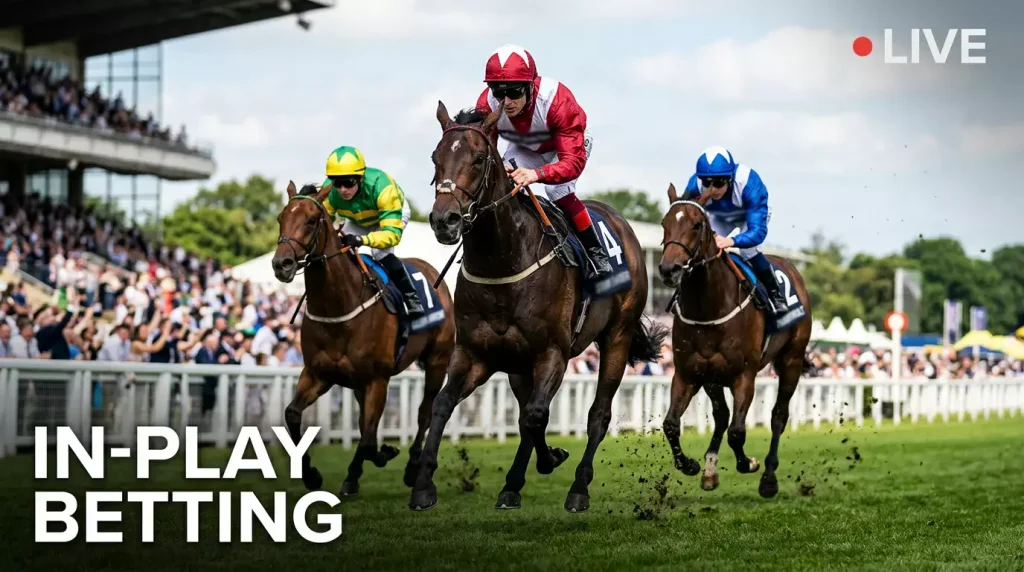
Betting While the Hooves Are Hitting the Ground
In-play horse racing betting compresses the entire decision-making process of a standard bet into a window measured in seconds and minutes. From the moment the stalls open to the moment the winner crosses the line, the market is alive — prices shifting in real time as horses take up positions, challenge for the lead, jump fences, and make their runs. It is the most dynamic form of horse racing wagering, and it is growing in popularity as live streaming and mobile betting make it possible to watch and bet simultaneously from anywhere.
But in-play racing is not simply faster betting. The information environment is fundamentally different. Pre-race, you have time to study the form, assess the market, and place your bet with deliberation. In-running, the market reacts to visual information — the position of the horse, its jumping, its jockey’s body language — that arrives at different speeds depending on whether you are watching a live stream, following on the course, or relying on data feeds. The race is still the market. Understanding the mechanics and the limitations of that market is what separates in-play punters who trade profitably from those who press buttons on instinct.
How In-Play Horse Racing Markets Work
In-play horse racing betting operates on two distinct platforms: traditional sportsbooks and betting exchanges. The mechanics differ significantly between them, and the choice of platform shapes what is possible during a race.
On a sportsbook — bet365, William Hill, Coral, and the other major operators — in-play betting on horse racing is offered through the standard bet slip interface. The bookmaker sets the in-running prices using an algorithm that factors in the pre-race market, the current position of each horse, and the distance remaining. These prices update every few seconds, and the bookmaker may suspend the market entirely during rapid changes — approaching a fence, for example, or in the closing stages of a close finish. When the market is suspended, no bets can be placed. When it reopens, the prices may have moved dramatically.
On Betfair Exchange, in-play trading is the core of the product. The exchange does not set prices — they are determined by the bets placed by other users. During a race, the exchange market is continuous: you can back or lay any horse at any moment, provided there is liquidity at the price you want. The Betfair Exchange raised its base commission to 6% for UK horse racing in June 2025, but for in-play traders who make multiple transactions per race, the exchange’s peer-to-peer model typically offers tighter effective margins than a sportsbook’s algorithmic in-play prices.
Latency is the critical variable in both environments. The delay between what is happening on the course and what you see on your screen — whether through a live stream or a data feed — ranges from 5 to 15 seconds on most bookmaker streams. On an exchange, the market reacts to what the fastest participants are seeing, which means that by the time your stream shows a horse making a move, the exchange price may already have shortened. This information asymmetry favours punters with the lowest latency — typically those watching dedicated racing channels with minimal delay, or in rare cases those at the course itself.
In-Play Strategy: What Works and What Looks Easier Than It Is
The most common in-play strategy in horse racing is laying the leader. The logic is statistical: in many races, the horse that leads at the halfway point does not win. Front-runners tire, get caught by closers, or jump badly at a critical obstacle. By laying the leader in-play on an exchange — betting against it winning — you are positioning yourself to profit if the lead changes hands. The risk is that the leader does not stop, and you are left with a liability on a horse that goes on to win comfortably.
The reverse approach — backing closers — involves identifying horses that tend to come from behind and backing them in-play when they are still at a longer price. This requires race-reading ability: watching how a horse is travelling, how much ground it has to make up, and whether the pace in front is likely to collapse. Greg Ferris, Managing Director of Sports at Entain, has noted that the breadth of customer engagement across live sporting events continues to expand, with in-play markets on horse racing contributing to that growth. The appeal is obvious — in-play betting transforms the passive experience of watching a race into an active, decision-rich engagement.
Trading — backing at one price and laying at another to lock in a profit regardless of the result — is the most sophisticated in-play strategy and is almost exclusively practised on exchanges. The principle is the same as trading a financial instrument: buy low, sell high. If you back a horse at 8.0 (7/1) before the race and it is trading at 4.0 (3/1) halfway through, you can lay it at 4.0 to guarantee a profit whichever horse wins. The profit comes from the difference between your back and lay prices, minus the exchange commission. According to Limelight Digital, 95% of online bets are placed from home — which means most in-play traders are working from a sofa with a laptop and a live stream, not from the grandstand.
A more conservative approach is using in-play markets to hedge pre-race bets. If you backed a horse at 10/1 before the race and it is travelling well at the two-furlong pole, the in-play price will have shortened considerably. Laying it on an exchange at the new shorter price locks in a portion of your profit while still leaving upside if it wins. This is not a full in-play trading strategy — it is risk management applied to an existing position — and it suits punters who want some in-play engagement without committing to the speed and intensity of full in-running trading.
The Risks of In-Running Betting
The speed of in-play horse racing creates risks that do not exist in pre-race betting. The most dangerous is overstaking under pressure. When a race is unfolding and your position is moving against you, the temptation to increase your stake to recover is immediate and visceral. In-play markets reward discipline and punish impulsiveness, and the compressed timeframe means there is no cooling-off period between decisions. If you are prone to chasing losses, in-play horse racing will amplify that tendency, not contain it.
Delayed streams create a false sense of information advantage. If you are watching a bookmaker’s stream with a 10-second delay and trying to bet on the exchange where professionals are reacting to zero-delay feeds, you are trading against people who are literally watching the future relative to your screen. The price you see may not be the price you can execute at, and the position you think you are taking may already have been overtaken by events you have not yet seen.
Connection drops are a practical risk that catches out even experienced in-play bettors. If your internet connection drops during a race while you have an open position on an exchange, you cannot close it until the connection is restored — and by then, the race may be over and the result decided. Using a stable Wi-Fi connection rather than mobile data, having a backup connection available, and keeping your exposure manageable are basic precautions that reduce the impact of a technical failure at the worst possible moment.
In-Play Horse Racing Betting — More on this topic at horse racing sportsbook.
See also Horse Racing Place Terms.
