
UKGC Licensed Betting Sites: How to Verify Your Horse Racing Bookmaker
 Available in US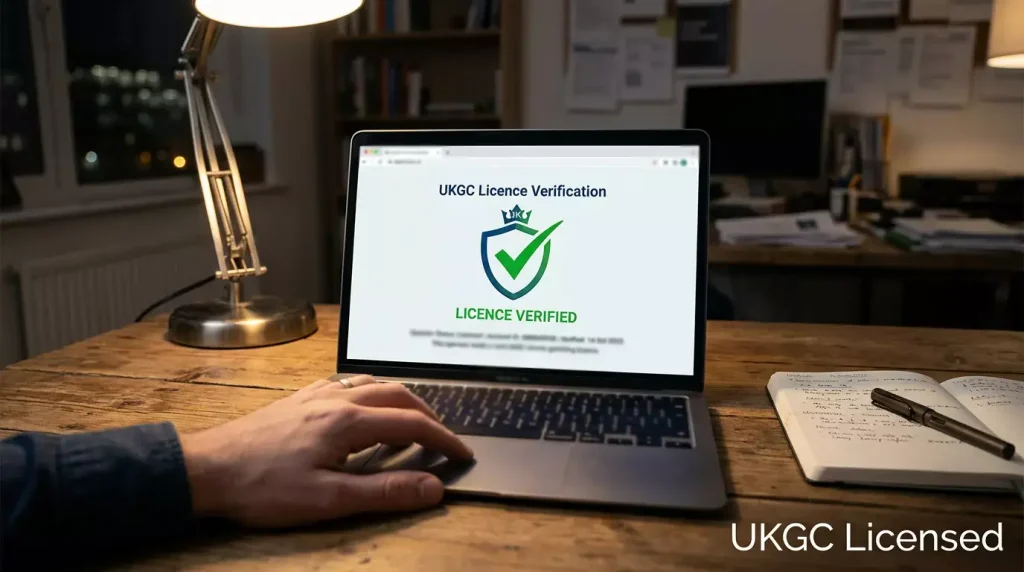
Why Licensing Is the First Thing You Should Check
Every bookmaker that legally offers horse racing betting to customers in the United Kingdom holds a licence issued by the UK Gambling Commission. That licence is not a badge of prestige or a marketing certificate. It is a legal requirement, and it comes with enforceable obligations that protect your money, your data, and your rights as a customer. Without it, a betting site can take your deposits, refuse to pay your winnings, and disappear — and you will have no regulatory body to turn to, no complaints process to invoke, and no legal recourse under UK law.
The importance of that distinction has never been sharper. According to a study published by the International Federation of Horseracing Authorities through the BHA, traffic to unlicensed betting sites accepting wagers on British horse racing has grown by 522% since 2021. That is not a rounding error — it is a five-fold increase in the number of UK punters risking their money with operators who are not subject to any of the protections that the UKGC framework provides. Licensed means accountable. Everything that follows from that accountability — fund protection, fair dispute resolution, responsible gambling tools — is what separates a regulated bookmaker from a website with odds on it.
How to Verify a Bookmaker’s UKGC Licence: Step by Step
The Gambling Commission maintains a public register of every licensed operator, which is freely accessible on its website. Checking whether a bookmaker holds a valid licence takes less than a minute. Navigate to the UKGC’s “Public register” page, enter the operator’s name or licence number, and the register will show you whether the licence is active, what type of licence it is, and any conditions or sanctions that have been applied.
There are two types of licence to look for. An Operating Licence authorises the company to provide gambling services — this is the licence that allows the bookmaker to accept bets from UK customers. A Personal Management Licence is held by senior individuals within the company (directors, compliance officers) and exists to ensure that the people running the business are fit and proper. If you search for a well-known bookmaker like bet365, William Hill, or Coral, you will find both types listed under the parent company name.
When checking the register, pay attention to the licence status. “Active” means the operator is currently authorised to accept bets. “Suspended” means the UKGC has temporarily halted the operator’s authority, usually due to a compliance investigation. “Revoked” means the licence has been permanently removed. If you cannot find a bookmaker on the register at all, it is either unlicensed or operating under a different parent company name — in the latter case, the operator’s website should display the UKGC licence number in its footer, which you can then verify directly.
Red flags that should prompt a check include: no UKGC licence number displayed on the website, a licence number that does not match the register, the absence of responsible gambling tools (deposit limits, self-exclusion, reality checks), and customer service that is unresponsive or based entirely outside the UK. Legitimate UKGC-licensed bookmakers display their licence number prominently, usually in the footer of every page, and provide direct links to the UKGC register for verification. If the information is missing or hard to find, treat that as a warning.
What a UKGC Licence Guarantees for Your Money and Your Rights
A UKGC licence imposes a set of conditions on the operator that directly benefit the customer. The most important of these relate to how your money is held, how disputes are resolved, and what tools are available to help you manage your gambling.
Fund protection is the foundation. UKGC-licensed operators are required to keep customer funds separate from their own business accounts, in a manner that protects those funds if the company becomes insolvent. The level of segregation varies — some operators use fully ring-fenced accounts, others use a medium-protection model — but the principle is the same: your deposited money should not be available to the bookmaker’s creditors if the business fails. Without a licence, there is no fund protection requirement, and your deposit is simply part of the operator’s general cash flow.
Dispute resolution is another pillar. If you have a disagreement with a UKGC-licensed bookmaker — over a settled bet, a withheld withdrawal, or terms applied to a promotion — you have the right to escalate the complaint to an approved Alternative Dispute Resolution (ADR) provider. The bookmaker is legally required to inform you of this right and to participate in the ADR process. The resolution is independent, and the ADR provider’s decision is binding on the operator. The Betting and Gaming Council estimates that 1.5 million UK bettors currently use unlicensed operators, spending up to £4.3 billion annually with sites that offer no dispute resolution mechanism whatsoever.
Responsible gambling tools are a mandatory feature of every UKGC-licensed site. These include deposit limits (daily, weekly, monthly), loss limits, session time reminders, cooling-off periods, and self-exclusion through GAMSTOP — the national scheme that allows you to ban yourself from all UK-licensed gambling sites simultaneously. Withdrawal processing must meet minimum standards, and operators cannot unreasonably delay the return of your funds. The cumulative effect of these requirements is that a UKGC-licensed bookmaker operates within a framework designed to protect the customer at every stage of the betting journey — from registration through to withdrawal.
What You Lose When You Bet With an Unlicensed Operator
The appeal of unlicensed operators is usually one of two things: they either offer odds that appear slightly more generous (because they do not carry the 21% GGY duty or the Levy), or they bypass the affordability checks that some punters find intrusive. Neither of these advantages compensates for what you give up.
With an unlicensed operator, there is no ADR. If the bookmaker refuses to pay a winning bet, your only option is to accept the loss or attempt legal action in a jurisdiction that may not recognise your claim. There is no fund segregation — if the site closes, your balance vanishes. There are no responsible gambling tools mandated by regulation, so if you develop a problem, there is no cooling-off button, no deposit cap, and no GAMSTOP integration to fall back on.
Your personal data is also unprotected. UKGC-licensed operators must comply with UK data protection laws, including GDPR. Unlicensed operators are under no such obligation, and the data you provide during registration — name, address, date of birth, payment details — is stored on servers with no regulatory oversight. Data breaches at unlicensed gambling sites are documented and recurring, and victims have no practical recourse.
The most fundamental risk is the simplest: you have no guarantee that you will be paid. A UKGC-licensed bookmaker that refuses to honour a legitimate winning bet faces regulatory sanction, reputational damage, and potential licence revocation. An unlicensed operator faces none of those consequences. The odds might look attractive, but the single most important feature of any bookmaker is not the price it offers — it is the certainty that it will pay you when you win.
UKGC Licensed Betting Sites — More on this topic at horse racing sportsbook.
See also How to Bet on Horse Racing for Beginners.
