
Grand National Betting Guide 2026: Odds, Strategy & What to Watch
 Available in US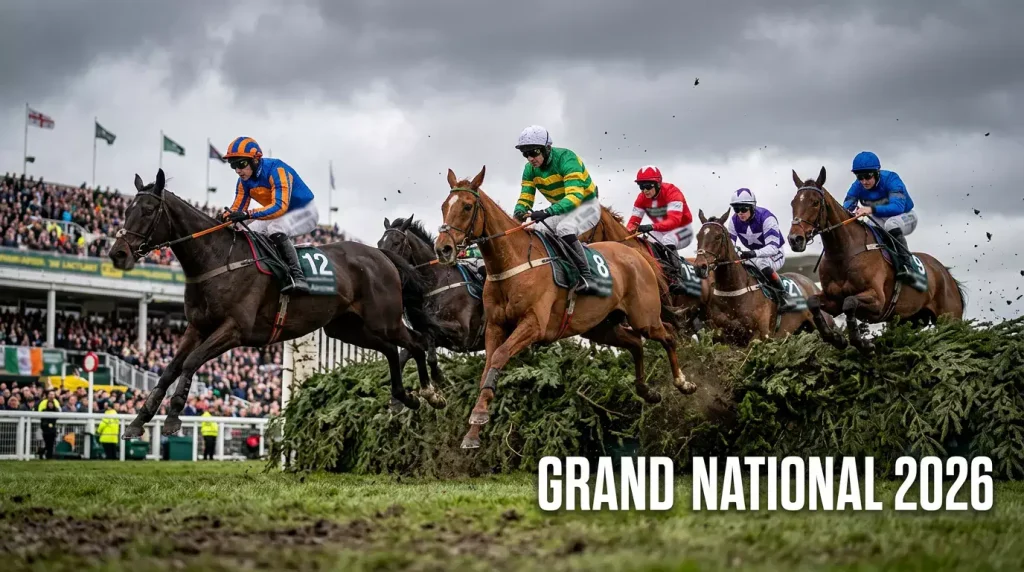
The Biggest Betting Event on the Planet
The Grand National is not just a horse race. According to Entain’s global data, it is the single most wagered-on sporting event in the world — generating 700% more bets than the Cheltenham Gold Cup and surpassing the Super Bowl for the second consecutive year. The three-day Aintree Festival around it attracts over £250 million in estimated betting turnover, with the Grand National itself accounting for more than £200 million of that figure.
No other race in British sport commands this kind of volume, and no other race draws in as many once-a-year punters. Roughly 17% of UK adults plan a bet on the Grand National in any given year, many of them placing their only horse racing wager of the entire calendar. That blend of hardcore racing fans and casual bettors creates a unique market dynamic — one where the odds are shaped as much by public sentiment as by cold form analysis. The race that stops a nation betting is also the race that attracts more money from people who do not normally bet on horses than any other event in sport. Understanding that dynamic is where any serious Grand National strategy begins.
The Race Itself: Four Miles, Thirty Fences, Forty Runners
The Grand National is run over four miles and two and a half furlongs at Aintree racecourse in Liverpool, making it one of the longest races in British racing. The course features 30 fences — 16 unique obstacles, with 14 of them jumped twice on the two-circuit layout. The fences are distinctive: they include Becher’s Brook, with its notorious drop landing, The Chair (the tallest fence on the course), and Canal Turn, where the field changes direction sharply after landing. These are not standard steeplechase fences. They are bigger, broader, and more demanding than anything the horses encounter during the rest of the season.
The maximum field is 40 runners, making it by far the largest field in British horse racing. In practice, the final field usually numbers between 34 and 40 after late withdrawals. The race is a handicap, meaning the weights are assigned by the BHA handicapper based on each horse’s official rating, with the highest-rated horse carrying the top weight and the others receiving weight allowances accordingly. The weight range typically spans from around 11st 10lb at the top to 10st 0lb at the bottom.
The combination of extreme distance, unique fences, and a huge field makes the Grand National inherently unpredictable. Horses fall, get brought down by other fallers, refuse at fences, or simply run out of stamina over the final half-mile. In a typical Grand National, fewer than half the field complete the course. That attrition rate is central to both the drama and the betting calculus: you are not just picking a horse that can run well — you are picking one that can survive.
The ground conditions at Aintree in April vary considerably from year to year. The going can range from Good to Firm on a dry spring to Soft or Heavy after prolonged rain. Because the race is so long and so demanding, the going has an amplified effect on the outcome: horses that thrive on soft ground gain a significant advantage when the heavens open, while firm-ground specialists struggle over four miles of energy-sapping terrain. Checking the going forecast in the days before the race is not optional — it is the single most important variable in narrowing the field.
Betting Strategy: Each-Way, Weights and What the Data Shows
The 40-runner field makes the Grand National a natural each-way race. Standard place terms for handicaps with 16 or more runners pay four places at 1/4 of the win odds, and during Grand National week most bookmakers extend this further — paying six, seven, or even eight places on the main race. That generous each-way structure means a horse finishing fifth or sixth can still return a profit on the place part of your bet, even if it never looked like winning.
A YouGov survey for OLBG found that 43% of people planning to bet on the Grand National in 2025 intended to stake less than £10, and that 77% of respondents agreed that betting on the race is part of British culture. These numbers tell you something important about the market: a significant proportion of the money is coming from casual bettors who pick horses based on names, colours, or stories rather than form. That public money tends to concentrate on a small number of well-known horses, which can create value further down the market on less fashionable runners that the crowd has overlooked.
Weight is the most statistically significant factor in Grand National outcomes. Historically, horses carrying between 10st 0lb and 10st 12lb have a significantly better record in the race than those at the top of the weights. The sheer distance and the jumping demands punish horses carrying more weight, and the handicap system means that higher-rated horses face a tougher physical test. This does not mean the top weight cannot win — it has, occasionally — but the probability distribution tilts heavily towards the lower end of the weight range.
Previous Aintree experience is another strong predictor. Horses that have completed the Grand National course before, or that have run well over the National fences in the Becher Chase or Grand Sefton in December, handle the unique obstacles with more confidence. First-time Grand National runners face a steep learning curve, and the completion rate among debutants is lower than among experienced horses. Trainer records at Aintree also matter: certain yards — Lucinda Russell, Gordon Elliott, Nigel Twiston-Davies — have accumulated strong Grand National records through sustained targeting of the race.
Grand National Promotions: What the Bookmakers Offer
Grand National week is second only to Cheltenham for bookmaker promotional activity. The sheer volume of once-a-year bettors means operators compete fiercely for sign-ups, and the range of offers typically includes enhanced odds for new customers, money-back specials, and extra-place promotions that can significantly improve the value of an each-way bet.
Money-back-if-your-horse-falls is the most distinctive Grand National promotion. Several bookmakers offer to refund your stake — usually as a free bet — if your selection falls, is brought down, or unseats its rider. Given the attrition rate in the race, this is genuinely useful insurance. The conditions vary: some operators apply it only to pre-race singles, others include each-way bets, and the maximum stake covered differs between bookmakers. Checking the specific terms before placing your bet is essential.
Extra places are the other major promotion. Where the standard terms pay four places, Grand National-specific offers from operators like bet365, Paddy Power, and William Hill frequently extend to six or eight places. On a 33/1 shot, the difference between four places and eight places can be the difference between a losing bet and a return of several pounds per unit stake. Ante-post Non-Runner No Bet terms are also widely available in the weeks before the race, giving you the option to back a horse early at a bigger price with the safety net of a refund if it does not make the final field.
There is, however, a shadow side to the Grand National’s enormous betting handle. Grainne Hurst, CEO of the Betting and Gaming Council, has highlighted that the unlicensed betting market absorbs roughly £10 million from the Grand National alone each year — revenue that fuels criminal activity, bypasses player protection, and drains funds from the sport. For punters, the practical implication is straightforward: stick to UKGC-licensed operators. The promotions, the fund protection, the dispute resolution, and the responsible gambling tools that licensed bookmakers provide are not available on the black market. On the biggest betting day of the year, that protection matters more than ever.
Grand National Betting Guide 2026 — More on this topic at horse racing sportsbook.
See also Royal Ascot Betting Guide 2026.
